

Fragmented referrals
Partners live in inboxes and personal spreadsheets. Nobody can say which source converted last month, and the partner never hears the outcome.

Solvhaus helps behavioral health organizations replace manual admissions, fragmented CRM workflows, and disconnected reporting with systems that scale.
When admissions, referrals, CRM data, and reporting live across disconnected tools, every new opportunity creates more operational strain. Solvhaus helps behavioral health teams build the systems that make growth repeatable.
Partners live in inboxes and personal spreadsheets. Nobody can say which source converted last month, and the partner never hears the outcome.
Speed-to-contact depends on who is on shift. Lost admits rarely get a recorded reason.
Occupancy is reconstructed every morning. BD cannot see what is actually open, so beds get promised twice.
Pending inquiries, partner callbacks, and alumni contact disappear when staff turn over.
Leadership gets three versions of the same week. Multi-location growth copies the mess.
Every exception routes to the owner's phone. Growth stalls at one person's memory and manual follow-up.
This is the workflow every treatment center runs, written down or not. When it runs on inboxes and memory, opportunities stall between stages and the operator becomes the bottleneck. When each stage has an owner, a next action, and a record, growth stops depending on who is on shift.
Five-stage admissions workflow: referral source, inquiry and intake, verification of benefits and clinical review, bed allocation, then CRM and EHR sync. Each stage lists where the manual version breaks.
Every stage needs an owner, a definition of done, and a place the outcome is recorded. That is the system BedFlow and the surrounding architecture are built to hold.
Set your monthly inquiries and how many records make it through each stage today. Then set what changes when every stage has an owner and a next action. The model does the arithmetic; nothing here is a promise.
Five stages from referral source to CRM and EHR sync. For each stage you set the share of records that advance, once for how it runs today and once for the version with owners and next actions. Bars show how many records enter each stage in each scenario, and the difference in placements per month at your volume.
| Stage | Today · enter | Today · leak | Target · enter | Target · leak |
|---|---|---|---|---|
| Referral source | 60 | 9 | 60 | 5 |
| Inquiry / intake | 51 | 15 | 55 | 10 |
| VOB / clinical review | 36 | 9 | 45 | 7 |
| Bed allocation | 27 | 5 | 38 | 4 |
| CRM / EHR sync | 21 | 2 | 35 | 1 |
| Placed | 19 | 34 |
This model runs on the numbers you enter. Defaults are illustrative placeholders, not client results, and nothing here is a forecast or a promise.
BedFlow is the clearest entry point for organizations that need a more structured way to manage admissions and referral operations: bed availability and census by program or house, a referral pipeline with owners, and authorization tracking on the same record.
Open, held, and occupied beds by program or house, updated by the people moving residents, visible to admissions and BD.
Referral sources, stages, and next actions on one record instead of a personal spreadsheet. The partner gets an outcome.
Auth dates, statuses, and next steps stay attached to the referral and the bed, so UR is not a side spreadsheet.
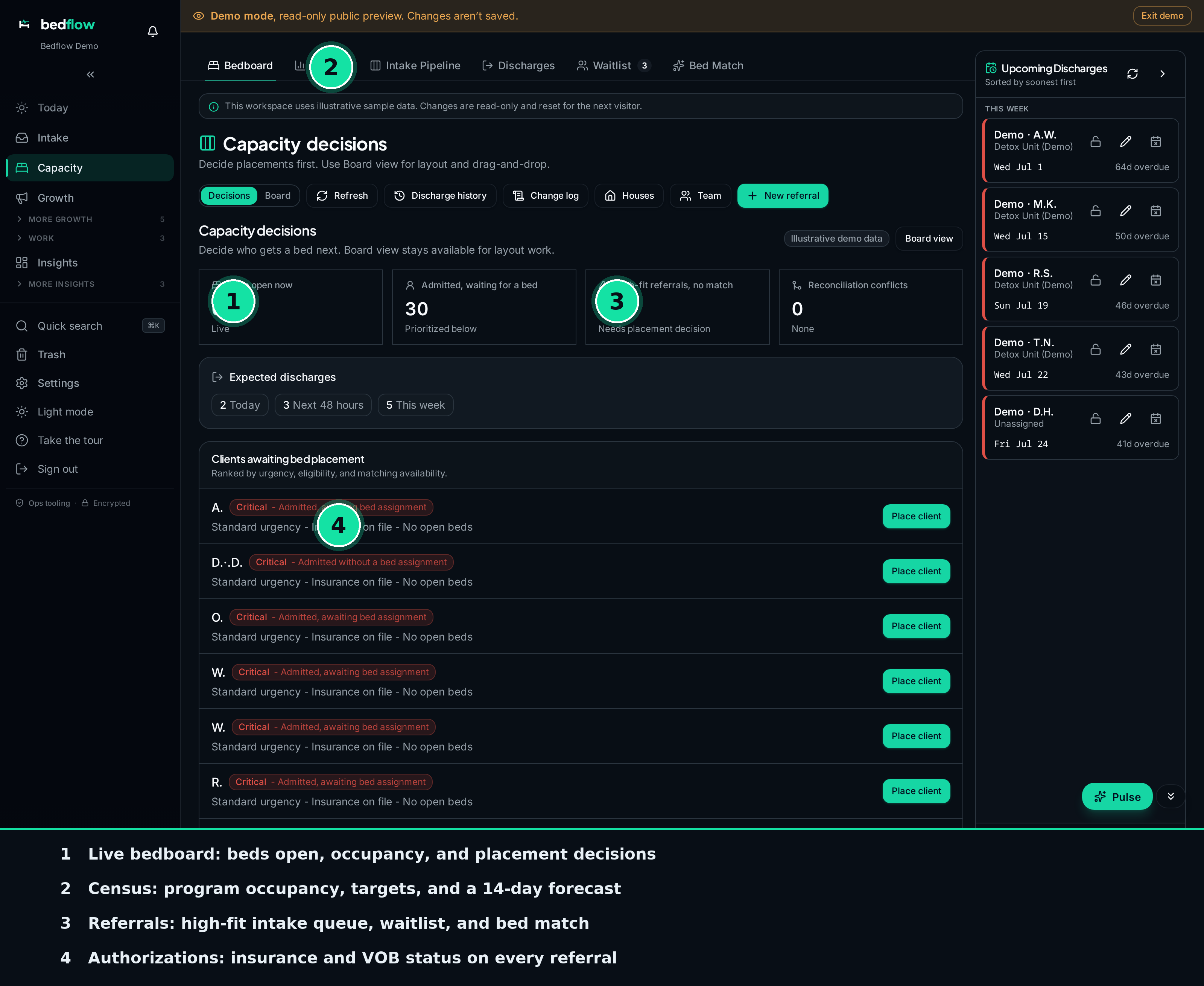
BedFlow does not replace your EHR, billing system, or clinical documentation. It sits beside them as the operational layer for referrals, BD, and capacity.
A simulated bedboard advancing one day at a time. Hover any bed or any day on the trend. None of it is client data.
A simulated program-level bedboard. Each square is a bed that is occupied, held, or open. Beds change state over time, and the sparkline records the occupied count for the trailing thirty days. Tonight: 30 of 38 occupied, 4 held, 4 open.
| Program | Capacity | Occupied | Held | Open |
|---|---|---|---|---|
| Detox | 6 | 5 | 1 | 0 |
| Residential A | 12 | 9 | 2 | 1 |
| Residential B | 12 | 8 | 1 | 3 |
| PHP step-down | 8 | 8 | 0 | 0 |
Every value on this chart is generated to show how the system behaves. It is not census, referral, or client data from any operator.
CRM architecture, automation, reporting, and digital systems exist to support the core admissions operation. Solvhaus designs the layers together so they read from the same records, whether the tool in the middle is BedFlow, a CRM we configure, or software we build.
Five connected layers: intake and admissions, CRM and referral relationships, operational data (census, authorization, alumni), leadership reporting, and the product tools that sit inside those layers.
Capture, first contact, VOB, clinical review, and placement, every stage owned.
Partner accounts, contacts, opportunities, and the admissions pipeline in one data model.
Census, authorizations, alumni contact, and house operations kept current by the people doing the work.
Routing, reminders, and refreshes on top of clean records, with a person on every decision.
Pipeline, source, census, and follow-up views that read from the same records across locations.
One architecture, five connected layers.
Close the loop from acquisition to census.
Five stages. Five places it breaks.
The data model comes before the software.
Same inquiry, two operations.
We work best when someone who owns the operation is in the conversation. If you need a vendor to “run ads,” we are the wrong room. If you need the infrastructure behind referrals, admissions, CRM, and growth, start here.
Owners, CEOs, and COOs of behavioral health clinics, treatment centers, and healthcare organizations who need the operation to hold without them in every thread.
Directors who live on referral conversion, speed-to-contact, and a pipeline everyone can read.
Independent and multi-location operators across levels of care, including sober-living and structured-living programs.
Teams that need the same operational spine: intake, CRM, automation, and reporting that agree with each other.
Each study is the operational problem, the system intervention, the verified result, and what it means for an operator. No blended percentages.
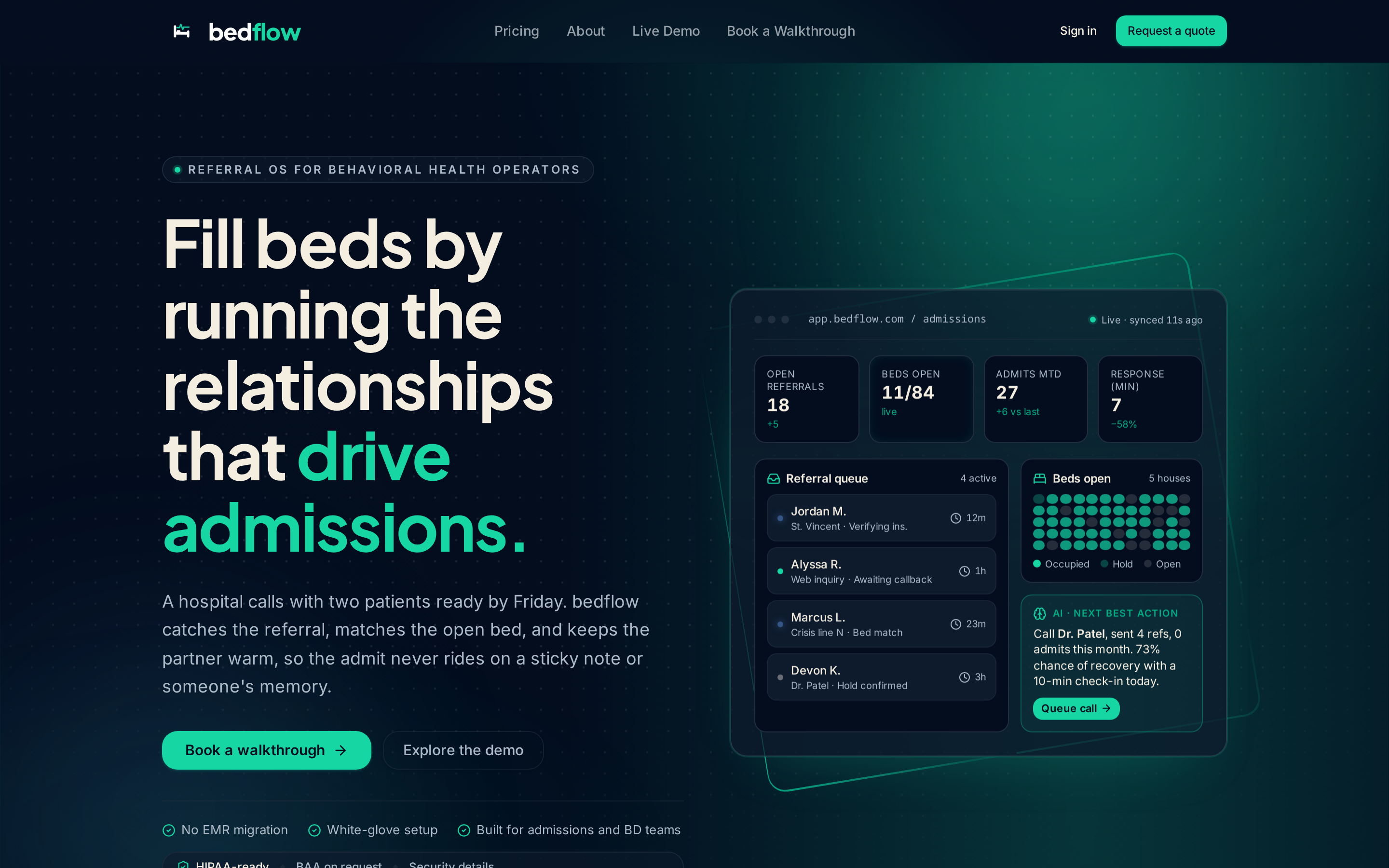
A referral-partner CRM for small-to-midsize treatment centers, pipeline and auth-tracking without forcing BD into the EHR.
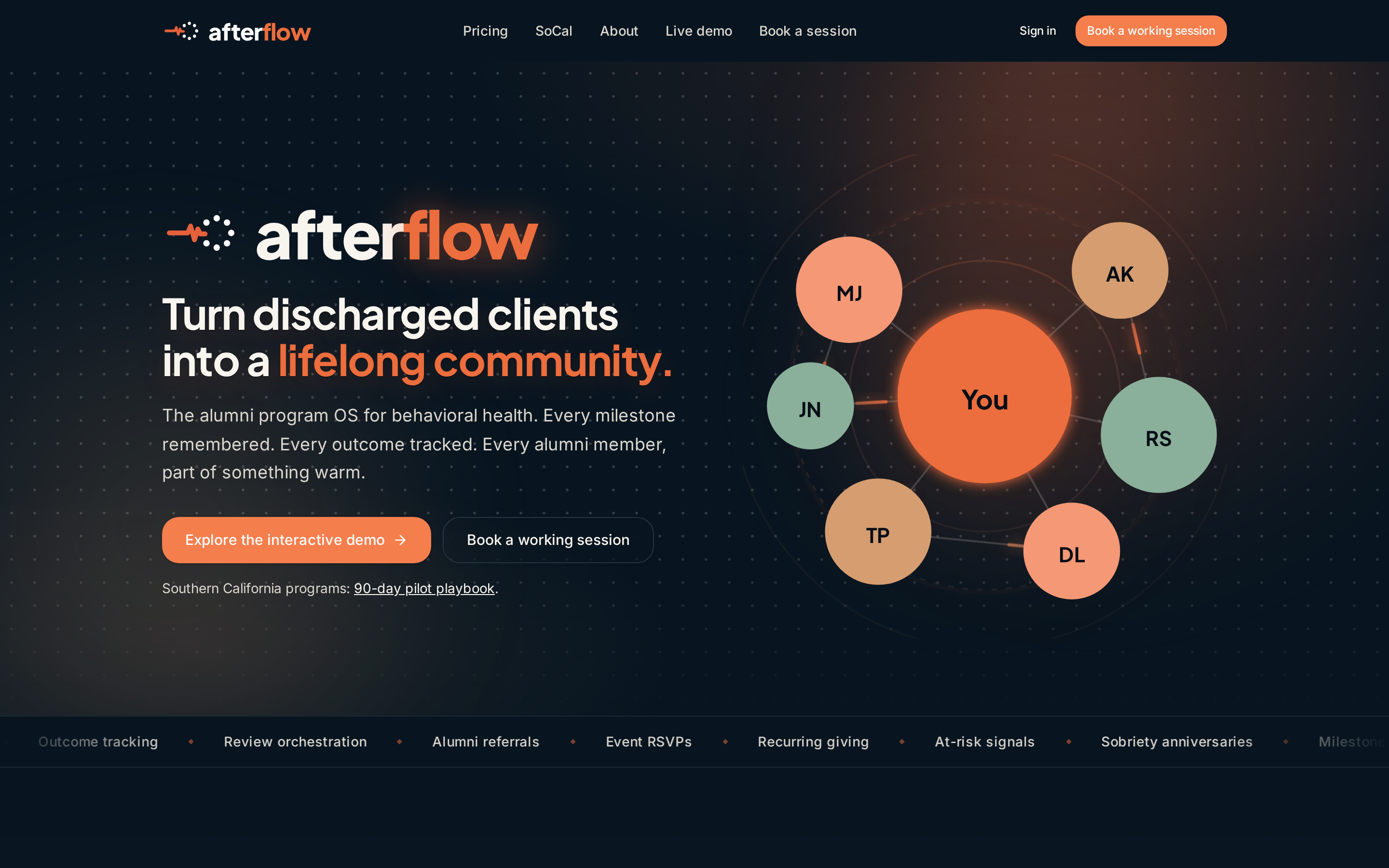
Alumni contact, milestones, and follow-up as an operation, not a forgotten spreadsheet.
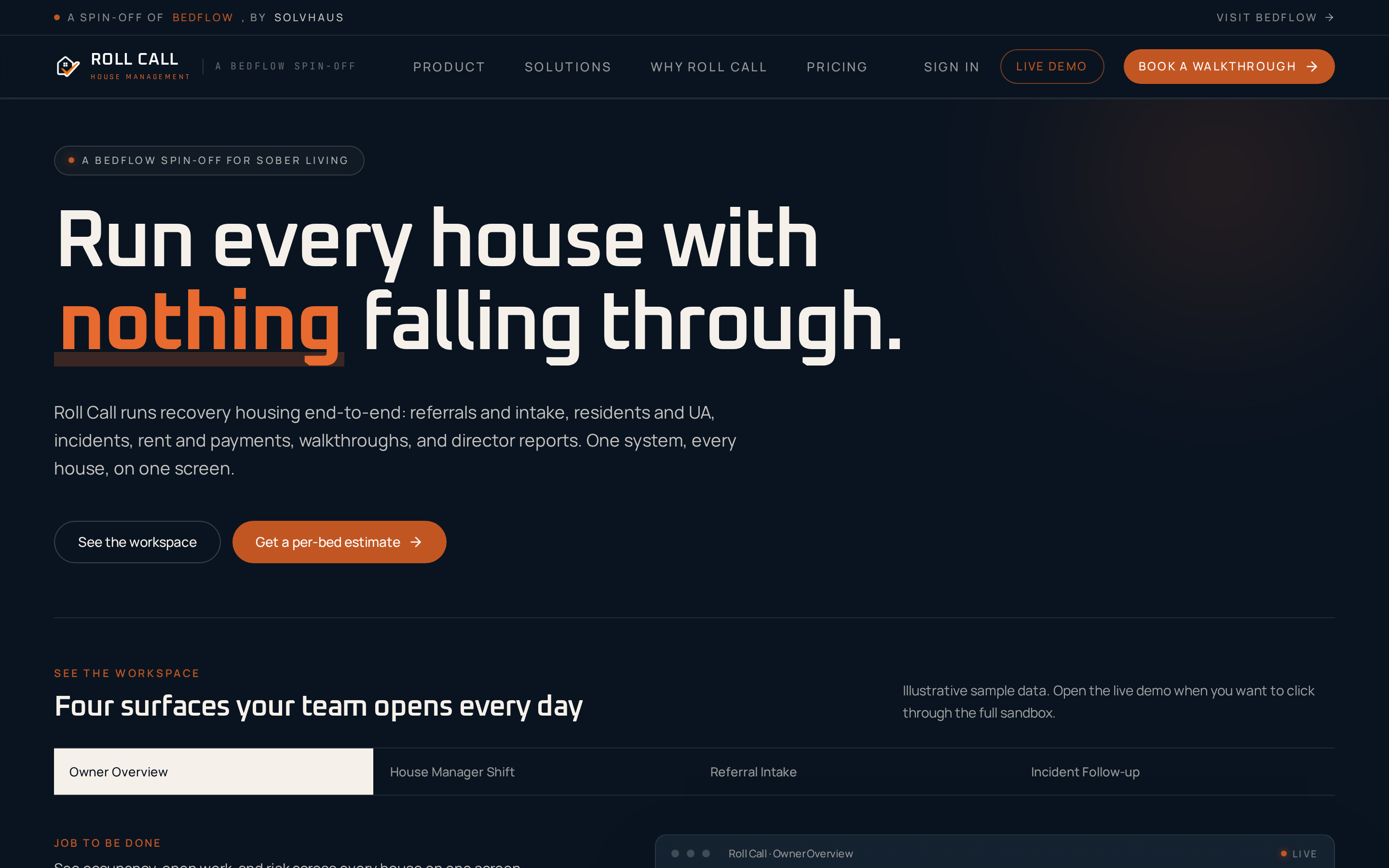
Census, check-ins, and house operations for recovery housing, in one record.
A family-facing treatment directory where visibility is not simply bought.
Built with treatment operators, admissions teams, and recovery networks
A systems conversation is for founders, executives, admissions leaders, and BD leads who need the infrastructure behind growth, not a pitch deck.